No products in the cart.
Archiv

Online-Dialogue “Home Office”
13 May 2020
“Home Office and Higher Education Institutions – more risk than reward?” This question was discussed by 59 people from 39 HEIs in an online dialogue organised by CHE Consult on 6th May 2020. This discussion was the first in a series initiated by CHE Consult. At present, the topic “home office” is more relevant than ever for HEI members. While working from home was previously an exception, this form of work has become common practice, owing to the coronavirus pandemic.
The following questions were discussed by the participants during the online dialogue:
- What are the risks associated with home office?
- What are the advantages?
- What experiences will you take with you for your HEI for the time after Corona?
At the beginning, Ms. John-Redeker (Head of Human Resources Development and Recruitment, TH Köln) and Prof. Dr. Salomo (Head of Department for Technology and Innovation Management, TU Berlin) each presented three theses on the topic. Afterwards, the participants had the opportunity to discuss and exchange ideas together. Three short surveys were also conducted.
Many of the participants shared the assumption that attitudes towards home office at their HEI will change for the better after corona and that it will be easier to work from home. However, some also had reservations about the impact of corona on home office practices at their HEIs. According to the respondents, the biggest challenges for university staff working from home are the compatibility of childcare and home office, the availability of technical equipment and the level of interaction with colleagues. However, most participants also saw opportunities for the time after Corona. A large number of them believed that it will become the norm for employees to be able to work from home and about half of them assume that their university will invest in additional technical equipment for this purpose.
Julia Klingemann, initiator and moderator of the online dialogue, is pleased about the great interest that was on display: “We are pleased about the large number of participants and the intensive exchange of experiences in this online format. This encourages us to continue along this path and to continue the dialogue as a series”.
The first online dialogue dealt directly with the topic of HR development. Based on four themes, which according to our consulting experience play an essential role in HR development concepts, namely
- Strategic HR planning
- Application Management & Onboarding
- Personal development for employees
- Leaving Experts
we would like to prepare another online dialogue that deals with the field of “Strategic HR Planning” or “Application Management & Onboarding”.
If you are interested in participating in upcoming exchange formats or have any further comments on the topic, please contact us and send an e-mail to laura.wallor(at)che-consult.de

Strategy for the Collections and Archives of the ETH
20 April 2020
The management of the ETH Zurich has adopted a new “Collections and Archives Strategy 2021 to 2024”. This marked the completion of a project lasting more than one year, which was supported by CHE Consult in cooperation with foresight company Z_punkt. The project was commissioned by the Vice President for Infrastructure Prof. Dr. Ulrich Weidmann, who has now also been tasked with implement the strategy by the Executive Board of the ETH Zurich .
At the conclusion of the project, Prof. Dr. Weidmann stated: “The strategy that has been developed provides a guiding framework for action for the coming years and aims at enabling the Collections and Archives department to make a significant contribution to the success of the university as a whole. The support provided by CHE Consult and Z_punkt helped us to involve various actors and stakeholders in a consensus-oriented and participatory manner. Through a target-oriented working process in practicable formats, forward-looking solutions supported by everyone involved were created”.
During the project, CHE Consult’s main tasks includedthe planning and management of the project,stakeholder management, moderation of various project groups, the conducting of extensive (online) surveys and providing advice on governance and outreach issues.
The Collections and Archives department of the ETH Zurich includes around 20 institutions that own Swiss cultural assets and valuable research data. The department constitutes a part of ETH Zurich’s basic mission to maintain, secure and ensure public access to these internationally significant and unique materials. The spectrum of items in its care include natural science and art history collections, archives and cultural-historical collections, as well as the literary estates of Thomas Mann and Max Frisch. The departmentalso hosts exhibition facilities as places of art education for the public and dialogue between scientific research and society.
The new strategy of the department is based on the values and strategic development plans of the ETH Zurich. Based on the vision and mission of the ETH Zurich, the project formulated strategic principles for seven thematic areas, ranging from research, teaching and dialogue with the public to the development of the collections, the protection of cultural assets, as well as cross-sectional issues such as digital change and the topic of organisation and cooperation. Points of action have been identified for each principle, which are to be implemented by means of measures that were developed in the strategy process.
In addition, measures were prioritised in each field of action and recommended for implementation in the form of projects. The focus is on promoting dialogue with the public and intensifying cooperation with the Departments of Research and Teaching.
Principal Consultant Julia Klingemann emphasizes the high level of cooperation among those involved in the project: “The trust placed in us external consultants by the management and staff of the Department of Collections and Archives was just as motivating as their commitment to their own individual concerns and the common goals of the ETH Zurich as a whole”.

Analysis of university websites: Foreign prospective students find a lot of information
09 March 2020
On behalf of the CHE Centre for Higher Education Development, CHE Consult has analysed the websites of universities. For this purpose, personas were developed, of five ideal-type prospective students who were interested in studying business administration. With reference to the personas, a questionnaire consisting of 69 individual questions was created, with which a sample of 32 university websites could be tested. The publication “Hochschulwebsites für heterogene Zielgruppen – Mit Personas Websites strategisch gestalten”, in addition to the analysis, contains eight central recommendations for action.
On behalf of the CHE Centre for Higher Education Development, CHE Consult has analysed the websites of universities. For this purpose, personas were developed for five ideal-typical prospective students who were interested in studying business administration. With reference to the personas, a questionnaire consisting of 69 individual questions was created, with which a sample of 32 university websites could be tested. The publication “Hochschulwebsites für heterogene Zielgruppen – Mit Personas Websites strategisch gestalten” contains eight central recommendations for action in addition to the analysis. (As above)
German universities respond to the individual information needs of prospective students on their websites to varying degrees. Foreign applicants are informed quite comprehensively. Persons without a school leaving certificate, on the other hand, find answers to relevant questions on the websites of the universities to a much lesser extent. This is shown by an analysis of the CHE Centre for Higher Education Development.
In light of the more than 20,000 courses of study currently on offer at around 400 German universities, orientation for prospective students is more important than ever. In addition to comparative overviews such as rankings or the Higher Education Compass, the websites of the universities serve a central orientation function.
A CHE analysis shows that German universities largely satisfy the information needs of foreign applicants. On average, a typical applicant from abroad receives answers to three quarters of relevant questions on the university websites. The situation is considerably worse for potential applicants without a high school diploma.
For the analysis, the CHE created five fictitious applicant profiles as representatives of typical target groups and developed a specific questionnaire for each. A random sample was used to determine which of these questions could be answered by research on the websites of selected universities. Universities of varying types and sizes were considered in the sample.
The ideal applicant profiles have proven to be very insightful. The remarkable insight they produced is that state universities tend to focus more on the special situation of students with children, from abroad or persons with a strong interest in research. Students without a high school diploma or with a more pragmatic and everyday-oriented view of their studies will find less relevant information on the net.
Private universities, according to the results of the sample, offer less concrete information on the net. The authors see a possible explanation for this finding in the fact that private universities pursue the strategy of quickly entering into direct dialogue with potential students and therefore do not attempt to answer as many questions as possible on the internet.
“It is a positive sign that at some universities the diversity on campus is also reflected in the specifically prepared information offered on the website”, co-author Ulrich Müller said, evaluating the results. “After all, what good is the best course of study if potential applicants do not feel they are being addressed with the relevant information and their questions are not being taken up,” says the head of political analysis at CHE.
The authors see potential for improvement in the structure of the websites. In many cases, the structure of the university itself, for example in terms of their faculties or departments, also dominates the structure of the website. However, this logic is not immediately comprehensible to prospective students and makes it more difficult to find relevant information or may lead to redundancies and contradictions.
One of the eight central recommendations of the analysis is therefore the organisation of university websites according to the specific needs of target groups. The use of fictitious profiles, so-called personas, as used in the CHE analysis, can provide valuable assistance here.
“The diversity among students will continue to increase,” predicts CHE expert Ulrich Müller. “Especially universiiesthat are located far from urban centers,, which have to fight harder for students, can score points with well-prepared information offers on the internet for specific target groups”, says Müller.

Erasmus+ Higher Education Impact Study
16 February 2020
CHE Consult and ICF Consulting have jointly prepared the Erasmus+ Higher Education Impact Study from January 2017 to April 2019. The study measures and analyses the impact that the Erasmus+ programme has on students who study abroad with the programme. It focuses on the development of individual competences, employability and a common European identity. In addition, the study analyses the effects of Erasmus+ mobility on the use of innovative teaching and learning methods by academic staff and the effects of the programme on institutions.
The study examined four main target groups and several subgroups: Erasmus+ students before and after their stay abroad, graduates with Erasmus+ experience, academic and non-academic staff and institutions involved in Erasmus+ projects. The results of the study are based on almost 77,000 responses. The participants include 47,000 students, 12,000 graduates and 10,000 employees of institutions.
During their stay abroad, Erasmus+ students explore what they would like to do in their lives. They experience new teaching and learning methods and strive for higher educational qualifications than non-mobile students. More than 70% of students say that they have a better idea of what they want to do in their future career after they participate in the Erasmus+ programme abroad. One quarter said they had reoriented their studies after the stay, with the experience abroad helping them. Erasmus+ also has an impact on students‘ personal life: One in five graduates said they met their partners during the Erasmus+ period abroad.
Erasmus+ students improved their labour market-related skills and their competences in terms of social cohesion. 9 out of 10 of the students interviewed said that they had improved in terms of adaptability, interaction with people from other cultures, communication skills and problem-solving abilities. More than half improved their digital literacy. 9 out of 10 graduates report that they use the skills and experience acquired during their Erasmus+ study in their current job. In terms of personal development, social engagement and openness to other cultures, Erasmus+ has a stronger impact than other mobility programmes.
Graduates with Erasmus+ experience find a job slightly faster than the control group without mobility experience in their studies. 3 out of 4 graduates with Erasmus+ experience believe that the stay abroad was beneficial in finding theirjob after graduation. 40 percent of those who completed an internship in the framework of Erasmus+ were offered an employment contract by the company at which they completed their placement.
Erasmus+ Academic mobility also improves the teaching and learning practices, as well as the broad skills and competences of higher education staff. 43% of academic staff who taught or learned abroad through the Erasmus+ programme integrated at least one new teaching method into their work, such as work-based learning for example. 60 per cent of teachers who participate in Erasmus+ at some point involve employees of companies in their teaching. This is a significantly higher proportion than the control group of teachers without corresponding experience abroad, where this happens in 40 percent of cases. The effects go beyond the change in participants’ practice. More than 80 per cent of the employees who are mobile abroad state that Erasmus+ has led to improvements in the development of innovative curricula and modern teaching practices in their faculty or department.

Market and potential analyses for eight study courses at the TH OWL
23 January 2020
CHE Consult has conducted market and potential analyses for eight courses of study at the OWL Technical University. The courses examined are the established Bachelor’s degree courses in Open Space Management and Precision Farming, as well as the planned Bachelor’s and Master’s degree courses in the fields of mechanical engineering,mechatronics, production and wood technology and energy and climate protection were examined.
The aim of the analyses was to provide insights for the decision on the introduction or further development of the study programmes and to create a basis for a marketing concept that takes into account both the demand and supply situation of the study programmes.
CHE Consult project manager Laura Wallor explains: “Universities are faced with the challenge of differentiating themselves from their competitors with their range of courses, while at the same time attempting to satisfy the interests of students and the labour market. Especially in the engineering sciences, many universities are struggling with declining numbers of first-year students, which stands at odds with the high demand for engineering graduates on the labour market and changing requirements as society becomes more digital. A data-based analysis can support the development of study programmes and marketing measures.“
The market and potential analyses examined general developments at the university and in the region. In addition, CHE Consult analysed each study programme with regard to student demand, relevant competitors and the demand for graduates on the labour market, including the specific requirements that employers are setting for graduates.
To this end, CHE Consult researched and evaluated quantitative and qualitative data and conducted guideline-based interviews with students and employers in the region. The results were summarised and presented in reports specific to the study programme. In addition, CHE Consult presented findings from a synopsis of the individual analyses to the presidential board.
“The results of the analysis provided by CHE Consult allow us to take an objective view of the potential of the new study programmes. The analysis of the specific target groups provides valuable information on sensible focal points in the design of the curricula and for the development of targeted marketing measures,” says Yvonne-Christin Bartel, Vice President for Education and Internationalization at the OWL Technical University.
Study Science Metropolis Hamburg
21 January 2020
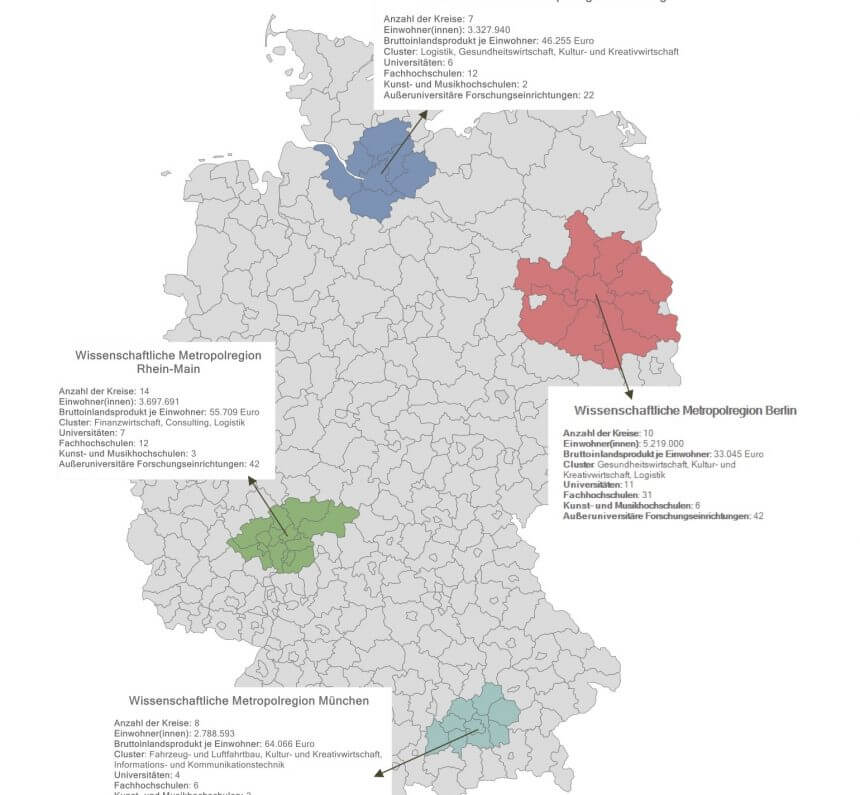
In a comparison of the 50 most important European metropolitan regions, Hamburg’s economy and thus the city’s competitiveness is falling continuously. In order to counteract this development, a consistent increase in research and innovation intensity in Hamburg is necessary.
To this end, the study recommends that Hamburg’s science policymakers develop a long-term, non-partisan and binding overall concept. Higher Education Institutions should be systematically expanded and given greater financial support. Cooperation between scientific institutions and with companies should be strengthened. Research funding should concentrate on clusters that promise economic success. In principle, Hamburg must understand and present itself as a city of science. This could be achieved if the city had the political courage and prioritisation of science to counteract the impending structural change.
The comparison of the metropolitan regions of Hamburg, Berlin, Copenhagen, Munich and Rhine-Main takes into account not only economic data, but also criteria such as research cooperations, patent applications, land policy, university start-ups, etc. and shows that determined science policy can significantly increase the competitiveness of metropolitan regions. As a city once dominated by its port, trade and logistics, Hamburg is one of the most deindustrialised metropolitan regions in Europe.
It is precisely against this background that the importance of science is increasing for Hamburg’s economic power and for securing the city’s prosperity, according to the authors of the study. Hamburg has already taken important steps in recent years and has achieved great success in the Excellence Initiative. However, in order for science to make a decisive contribution to Hamburg’s competitiveness, much more must be invested and the general conditions must be improved. In contrast to comparable regions, the general importance of science has not yet been sufficiently recognised by politics and society in Hamburg.
The study was made possible by funding from the Kühne Foundation, the Joachim Herz Foundation, the Körber Foundation, the Zeit Foundation, the German Chemical Industry Association, Joh. Berenberg, Gossler & Co. KG as well as the corporate association AGA. The study was initiated by Klaus von Dohnanyi, Wilfried Mayer and Wolfgang Peiner.
- October 2026
- August 2026
- June 2026
- May 2026
- March 2025
- February 2025
- October 2024
- September 2024
- August 2024
- April 2024
- March 2024
- January 2024
- November 2023
- September 2023
- August 2023
- July 2023
- June 2023
- December 2022
- August 2022
- July 2022
- June 2022
- May 2022
- October 2021
- May 2021
- December 2020
- July 2020
- May 2020
- April 2020
- March 2020
- February 2020
- January 2020